
Christmas
As a small child I looked forward to Christmas every year. Presents, cookies, Santa sliding down our chimney to deliver presents based on my good works during the year. It never occurred to me to consider how one man in a red suit pulled by magical flying reindeer could circumnavigate the globe, go down every chimney and deliver presents to billions of people in a short 24-hour period. It never occurred to me to consider Christmas as anything other than the birth of Jesus. What a fun celebration. Then I grew up and could read what the Bible has to say and what history has to say. As a 12-year-old I was shocked by what the Bible did not say about Christmas and what history did say about Christmas. In looking further, I wondered what God had to say about celebrating days that are not His days. I was a budding young biblical historian looking for facts.
What God has to say about adding to His worship.
God is explicit in telling His people NOT to mingle with and add pagan religion and culture to the worship of the true God. God said, “You shall not add to the word which I command you, nor take from it, that you may keep the commandments of the Lord your God which I command you.” (Deut. 4:2 NKJV). As God’s children we are told by God to keep His commandments and not any other man-made days. “When the Lord your God cuts off from before you the nations which you go to dispossess, and you displace them and dwell in their land, 30 take heed to yourself that you are not ensnared to follow them, after they are destroyed from before you, and that you do not inquire after their gods, saying, ‘How did these nations serve their gods? I also will do likewise.’ 31 You shall not worship the Lord your God in that way; for every abomination to the Lord which He hates they have done to their gods; for they burn even their sons and daughters in the fire to their gods. 32 “Whatever I command you, be careful to observe it; you shall not add to it nor take away from it.” (Deut.12:30-32). Do not follow their ways, do not inquire after their gods, do not worship God as the heathen do. This cannot be more clearly stated.
We are to honor and obey God above all else and only God has the authority to decide what is right and wrong. We are to keep God’s days, not man’s (Deut. 4:13-14). We are not to add or mix in our days of worship with God’s days (Pro. 30:6). We must not preach another gospel (II Cor. 11:3-4). Those who do preach another gospel are “false prophets” and are in league with Satan himself (II Cor.11:13-15.) If we preach and teach “another gospel” we are accursed (Gal. 1:6-8). Christians are not to go back to their prior pagan doctrines, the “weak and beggarly” elements of man’s false pagan religions (Gal. 4:8-11). We must remove ourselves from the traditions of men (Col. 2:8). God’s Holy Spirit is to lead us; we are not to follow the lead of natural man (I Cor. 2:12-14). We should not be unequally yoked together with unbelievers (II Cor. 6:14-18). Do not worship God in vain (Matt. 15:9 and Mark 7:7). We are to worship God in spirit and truth (John 4:23-24). We are not to imitate evil (III John 11). We are not to follow the doctrines of Balaam (Rev 2:14).
What history has to say about Christmas.
Christmas is said to be the birthday of Christ, and we are told by the “Christian” world to celebrate his arrival on earth as a human being, yet no one knows the exact day of His birth. Do we realize Christmas is not only not mentioned or commanded to be kept in the Bible, but it is in fact of a pagan origin and December 25th is nowhere near when Jesus was born? Christ’s apostles did NOT celebrate His birth. The early church did NOT celebrate His birth. “…within the Christian Church no such festival as Christmas was ever heard of till the third century, and that not till the fourth century was far advanced did it gain much observance.”[1] Christmas was NOT a Christian celebration in the first three hundred years after the beginning of the Church in Jerusalem. We also see the church did not “introduce[ed] so late as 350-440 a Christmas feast until then unknown…”[2] December 25th was not a part of any Christian festival until Rome made it so.
December 25th was already celebrated around the world by pagan cultures to commemorate the winter solstice and the worship of the “Sun” God. It was celebrated in pagan ancient Persia to worship Mithraism, whose followers worshipped the Sun. Anciently gifts were exchanged on the Roman Saturnalia, a feast to the god Saturn and was a part of the emperor worship. Persia, Assyria, Babylon, Egypt, Greece, Rome, early Britain, Caledonia (Scotland), Germany, Gaul (France), Ireland and countries of the east all worshipped the “Sun” God on December 25 for hundreds of years BEFORE the birth of Christ in honor of the winter solstice and the “Sun” God.[3] “It seems likely that Christmas has origins in ancient winter solstice celebrations expressing a longing at the darkest time of the year for the return of the light, as in the case of the Roman festival of Sol Invictus.”[4] There is no historical doubt as to the pagan sun worshipping origin of our modern Christmas celebrations.
Historically, “Yule marks the rebirth of the sun’s power. In the Roman tradition it was the festival of Sol Invictus, the Undefeated Sun. In several major religions, the birth of the chief god, identified with the sun, has been celebrated at this time. The Egyptian sky goddess Nut was said to give birth to the sun at the winter solstice, and the birthday of the sun-son in many religions, including Horus, Helios, Dionysos, Mithras, and Jesus, has been celebrated on 25 December, the old date of the winter solstice. The common feature of these mid-winter divinities is that all are associated with concepts of rebirth and eternal life.”[5] Giving birth to the Son of God in the exact form of giving birth to the sun-son God is a remarkable carryover of heathenism to false Christianity. “That Christmas was originally a Pagan festival, is beyond all doubt.”[6]
Christmas is the new transformed name used in place of the worship of the Sun god of ancient times. Christmas was grafted into the Roman church because the worship and merriment of the worship of the Saturnalia Sun god was too powerful to overcome. Nothing about Christmas is of any Christian origin and nothing of it honors God. It is an ancient pagan worship made to look like the worship of the “Son” of God in place of the “Sun” God.
Why would the “church” graft in paganism? “One of the principal causes was that almost all nations regarded the winter solstice as the turning point of the year—the beginning of the renewed life and activity of the powers of nature. At the winter solstice the Norsemen held their Yule-feast in commemoration of the fiery sun-wheel…Many of the usages of the Germans and Romans were adapted from heathenism to Christianity.”[7] The church could not overcome evil with good, so it brought in the evil to make it look good.
Christmas today is an ancient compilation of pagan ritualism made to look like a Christian observance. “That much of our association with the Christmas season—the holidays, the giving of presents and the general feeling of geniality—is but the inheritance from the Roman winter festival of the Saturnalia…survivals of paganism.”[8] Continuing on, “…all of the festivities of the winter solstice have been absorbed into Christmas day.”[9] God said not to add to His ways or to follow the ways of the pagans (Deut. 4:2; 12:30-32) yet this is precisely what Christmas is. Christians should never be associated with any pagan festival. Amazingly the pagans did not abscond with Chrisitan festivals but held firm to their heathen beliefs. “…how much more faithful are the heathen to their religion, who take special care to adopt no solemnity from the Christians.”[10]
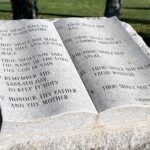
Santa Claus is a lie. Going down chimneys and delivering presents is a lie. Jesus was born on December 25 is a lie. The 9th commandment says not, “to bear false witness”. We are not to follow the way of the world (See Jeremiah 10:2-6 for a description of how the world worships false gods). We are not to mix God’s true religion with pagan false religion (II Cor. 6:14-18).
The truth is Jesus was born, lived a perfect sin free life, was crucified and died for precisely three days and three nights. He then rose from the dead and returned to God the Father. This is what the Bible teaches us to worship, Jesus Christ in all His glory. We are not to worship Him with false gospels, but we are to worship in spirit and in truth (John 4:24). Christmas is a pagan custom and not to be participated in by God’s family of Christian believers.
Mike Wallace
[1] Alexander Hislop, The Two Babylon’s or The Papal Worship Proved to be The Worship of Nimrod and His Wife. (Neptune: Loizeaux Brothers,1959),93.
[2] Encyclopedia Britannica, 11th ed. Published 1910, Vol. 6. “Christmas”, 294.
[3] David Leeming, The Oxford Companion to World Mythology. (Oxford: Oxford University Press,2005),76-77.
[4] Leeming, 77.
[5] Nigel Pennick, The Pagan Book of Days: A Guide to the Festivals, Traditions, and Sacred Days of the Year. (Rochester: Destiny Books, 2001),20.
[6] Hislop, 93.
[7] Funk & Wagnalls New Standard Encyclopedia of Universal Knowledge. Published 1934, Vol. VI. “Christmas”, 338-339.
[8] Ralph Woodrow, Babylon Mystery Religion. (Ralph Woodrow Evangelistic Association, Inc.: Riverside, 1966), 152.
[9] Woodrow, 152.
[10] Hislop, 93.