James, The Book of
Question: How many people named James were apostles?
To understand the book of James we must first know who James was and what was his cultural background.
Note: All verse quotations will be from the NKJV, unless otherwise noted.
A short introductory biography of James, brother of John (Not the author of the book of James).
First, we start with James, the brother of John. We do this because many people do not believe Jesus had any brothers or sisters.
James “the Great”, the elder brother of John the Apostle one of the “Sons of Thunder” (Possibly first cousin of Jesus).
Originally a fisherman in partnership with John and Peter. James, Peter and John were the three with Jesus at the “Transfiguration” Matt 17:1, the raising of Jairus’s daughter Mark 5:37 and at the garden of Gethsemane during the last night of the life of Jesus.[1] James “the Great” was one of the most important Apostles yet he was the first to be killed for his belief in Christ c44 AD by Herod with a sword. See Acts 12:2. “Unlike ALL the other apostles, we know exactly what happened to him after the time of Christ.”[2] He was murdered in Jerusalem by Herod.
There is simply no evidence of him ever leaving Jerusalem. There are numerous spurious accounts of James traveling to Spain and then returning to Jerusalem in time to be killed. Not one of these spurious traveling events has any sustainable fact in history and must be totally discounted as legend. Unger even says, “Many legends are recorded of James, but as they have no good foundation, they had better be omitted.”[3]
While dying on the cross Jesus gives His mother to John younger brother of James for safe keeping. Why would He do this? 1) It was a legal maneuver to make sure His family was properly taken care of (John 19:26-27). 2) Why did Jesus choose John for this task and how did it affect the future ministry of the apostle John and his brother James? There are three verses to help us understand the first part of this question. Matt. 27:56, As Jesus was dying…“among whom were Mary Magdalene, Mary the mother of James and Joses, and the mother of Zebedee’s sons.” Mark 16:1 “Now when the Sabbath was past, Mary Magdalene, Mary the mother of James, and Salome bought spices, that they might come and anoint Him.” John 19:25 “Now there stood by the cross of Jesus His mother, and His mother’s sister, Mary the wife of Clopas, and Mary Magdalene.” Salome was sister of Mary the mother of Jesus. The legal move to make John the guardian of Mary, mother of Jesus was family business. It seems both James and John stayed in the area of Jerusalem for the formative years of the Christian Church. James and John were likely first cousins of Jesus.
As we have seen, James the brother of John was possibly first cousin to Jesus, yet sadly, Jesus allowed him to be murdered. (Acts 12:1). However, the situation was avenged by Jesus. “Beloved, do not avenge yourselves, but rather give place to wrath; for it is written, “Vengeance is Mine, I will repay,” says the Lord.” (Rom. 12:19 [NKJV]). “Now Herod had been very angry with the people of Tyre and Sidon; but they came to him with one accord, and having made Blastus the king’s personal aide their friend, they asked for peace, because their country was supplied with food by the king’s country.21 So on a set day Herod, arrayed in royal apparel, sat on his throne and gave an oration to them. 22 And the people kept shouting, “The voice of a god and not of a man!” 23 Then immediately an angel of the Lord struck him, because he did not give glory to God. And he was eaten by worms and died.24 But the word of God grew and multiplied.” (Acts 12:20-24). This marks the end of James, brother of John. All references to “James” after this time point to a different James. We know after this time James the brother of Jesus is the James of Acts and the book of James.
We must not forget the second James who was an apostle. “James the Less, another of the twelve apostles. He was the son of Alphaeus (Matt. 10:3; Mark 3:18; Luke 6:15; Acts 1:13) and Mary the sister of our Lord’s mother (Matt. 27:56; Mark 15:40; Luke 24:10; John 19:25), and was called James the Less (ho mikros, the little) because he was younger than James the son of Zebedee, or on account of his low stature (Mark 16:1).”[4] They might have nick named him shorty. We last hear of this apostle James early in the book of Acts. “And when they had entered, they went up into the upper room where they were staying Peter, James, John, and Andrew; Philip and Thomas; Bartholomew and Matthew; James the son of Alphaeus and Simon the Zealot; and Judas the son of James.” (Acts 1:13). From this point on, apostle James the less is never heard from again.
The Original 12 Apostles
“Then He appointed twelve, that they might be with Him and that He might send them out to preach, 15 and to have power to heal sicknesses and to cast out demons: 16 Simon, to whom He gave the name Peter; 17 James the son of Zebedee and John the brother of James, to whom He gave the name Boanerges, that is, “Sons of Thunder”; 18 Andrew, Philip, Bartholomew, Matthew, Thomas, James the son of Alphaeus, Thaddaeus, Simon the Canaanite; 19 and Judas Iscariot, who also betrayed Him. And they went into a house.” (Mark 3:14-19 [NKJV]).
All Apostles of the New Testament listed:
1) Simon Peter (Cephas, Barjona)
2) Andrew
3) John- Son of Zebedee “Sons of Thunder” (Likely, first cousin of Jesus).
4) Philip
5) James- Son of Zebedee “Sons of Thunder” (Likely, first cousin of Jesus)
6) Bartholomew (Perhaps same as Nathaniel)
7) Thomas (Didymus)
8) Matthew (Levi)
9) Simon Zelotes
10) Jude (Lebbaeus, Thaddaeus)
11) James the Less (Son of Alphaeus), first cousin of Jesus
12) Judas Iscariot (Betrayed Jesus and died horribly).
13) Matthias to replace Judas Iscariot see Acts 1:26.
14) Barnabas
15) James the brother of Jesus
16) Saul/Paul
Note: Some say Jude, another brother of Jesus, who wrote the short epistle of Jude was also an apostle. This is debated and we do not know for certain as there is no explicit text of Jude being called an apostle.
“At the violent death of Stephen and because of the sternly repressive measures taken by the Jewish leaders to crush the new movement, the majority of Christians in Jerusalem were scattered abroad through Judea and Samaria. From this point to the last chapters of Acts little is said of the Jerusalem church. It was strongly Judaist in character and maintained some observance of the law, as the later controversies showed. The scattering of its adherents, however, resulted in numerous missionary projects…”[5] Many of the apostles seem to have scattered and followed what Jesus had said to them, “But you shall receive power when the Holy Spirit has come upon you; and you shall be witnesses to Me in Jerusalem, and in all Judea and Samaria, and to the end of the earth.”
Moving on to our third James of the New Testament.
James the brother of Jesus.
Did Jesus have a physical family of more than his mother Mary and his father Joseph? Using first the Bible and not tradition we will see what is said about the family of Jesus.
Matt. 13:55 “Is not this the carpenter’s son? Is not his mother called Mary? and his brethren, James, and Joses, and Simon, and Judas?”
Mark 6:2-4 “And when the Sabbath had come, He began to teach in the synagogue. And many hearing Him were astonished, saying, ‘Where did this Man get these things? And what wisdom is this which is given to Him, that such mighty works are performed by His hands! 3 Is this not the carpenter, the Son of Mary, and brother of James, Joses, Judas, and Simon? And are not His sisters here with us?’ So they were offended at Him. 4 But Jesus said to them, “A prophet is not without honor except in his own country, among his own relatives, and in his own house.”
Acts 12:1-3 James (the brother of John the apostle) and Peter are arrested by Herod and James is KILLED by Herod. Starting inActs 12:13-17 and further, verses are referring to James the brother of Jesus because James the brother John had been executed by Herod.
Let’s take a look at the references to James, brother of Jesus.
Acts 12:13-17
“And as Peter knocked at the door of the gate, a girl named Rhoda came to answer. 14 When she recognized Peter’s voice, because of her gladness she did not open the gate, but ran in and announced that Peter stood before the gate. 15 But they said to her, ‘You are beside yourself!’ Yet she kept insisting that it was so. So they said, ‘It is his angel.’ 16 Now Peter continued knocking; and when they opened the door and saw him, they were astonished. 17 But motioning to them with his hand to keep silent, he declared to them how the Lord had brought him out of the prison. And he said, ‘Go, tell these things to James and to the brethren.’ And he departed and went to another place.” (Acts 12:13-17). Peter is telling them to go tell James, the brother of Jesus as James the brother of John was dead.
Concerning the apostle Paul, “Then after three years I went up to Jerusalem to see Peter, and remained with him fifteen days. 19 But I saw none of the other apostles except James, the Lord’s brother.”
We learn much from this verse written by Paul. The original James the Apostle was killed by Herod fairly early in the history of the church (c44 A.D.). Paul calls the surviving James the Lord’s brother. And Paul calls James the brother of Jesus “Apostle”.
Jesus had a family, many of whom became his followers after his death and resurrection, but this is a study for another time.
What we do know is James of Acts 15 was the Lord’s brother. The James that wrote the book of James was the Lord’s brother. He replaced the original James the apostle (brother of the apostle John) as the leader of the church in Jerusalem. Why was James the brother of the Lord Jesus converted? Why and how the change of heart for James, brother of Jesus as he had grown up a doubter in a household of apparently many children to the utmost of belief and loyalty to the point of death in his own brother. Paul tells us why. “…and that He was seen by Cephas, then by the twelve. After that He was seen by over five hundred brethren at once, of whom the greater part remain to the present, but some have fallen asleep. After that He was seen by James, then by all the apostles.” (I Cor. 15:5-7).
Jesus, brother of James made a special appearance to James his younger brother after He had been resurrected. James believed with all his heart and soul that his own flesh and blood brother was God. What an astounding life James must have led.
QUESTION: How would one feel when you go from disbelief to full belief that your brother was the Messiah?
In Acts 15 it is James the brother of Jesus who presides over the council and renders his verdict on how to treat Gentile converts. “In CE 61 James suffered martyrdom at the instigation of the high priest Ananas after the sudden death in office of the procurator Festus (Josephus, Ant. 20.9.200).”[6]
JESUS ALLOWED HIS OWN PHYSICAL FLESHLY CHILDHOOD PLAYMATE BROTHER TO BE KILLED-MURDERED. How powerful a message to all of us to PREACH THE GOSPEL OF THE KINGDOM OF GOD no matter what the cost! Go forth. Do not look back like Lot’s wife. We, like James the brother of God in the flesh must live the Gospel. We must be the light on the hill and the salt of the earth. James knew who his brother was and he lived the life needed to teach the world of his elder brother. Can we not do the same?
It seems James, brother of Jesus stayed right in Jerusalem his entire apostolic career until murdered by the high priest of Judaism.
James
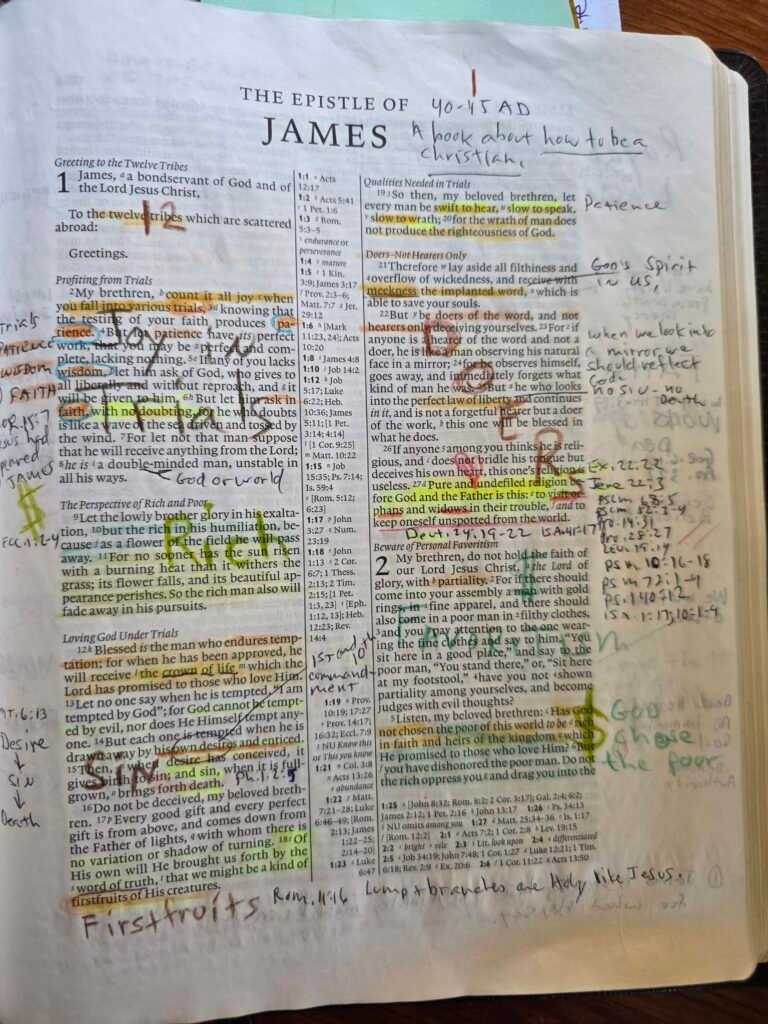
We begin the epistle of James by looking at two questions, 1) When was the book written? 2) Why was it written and what is James trying to tell us?
When: “Though not universally agreed upon, the evidence is strong that James is one of the oldest books in the New Testament…scholars assign a date of somewhere between A.D. 44 and 62.”[7] Because of the very Jewish nature of the book an earlier date is given more credence. The later date is given by Josephus.[8] Dates between 41 and 46 A.D. are commonly used for the writing of this epistle. It is possible James wrote this around the time of the incidents in Acts 12:1-2 when Herod Agrippa I killed James the brother of John. Immediately we see Peter referencing James, the Lord’s brother, as someone who seems to have authority in Jerusalem. “Now Peter continued knocking; and when they opened the door and saw him, they were astonished. 17 But motioning to them with his hand to keep silent, he declared to them how the Lord had brought him out of the prison. And he said, “Go, tell these things to James and to the brethren.” And he departed and went to another place.” (Acts 12:16-17).
Why and the messaging of James: James is writing to the church probably within ten to 15 years after the crucifixion is an indication of why. How are Christians to live? Christianity is a new faith with many questions to be answered. A few years after writing this epistle we see the church leaders gathered in Jerusalem in Acts 15 to discuss and settle theological matters. “The Epistle of James is the ‘how-to’ book of the Chrisitan life. It is one of the most practical books in the New Testament because it offers instruction and exhortation to Christians who are experiencing problems, as all of us do.”[9]
James is a great book for beginning Christians and for old and experienced Christians. “The believer must begin his or her Christian walk by faith. This faith is founded upon a personal belief in God the Father and Jesus Christ. Each believer must personally accept the sacrifice of Jesus Christ for the forgiveness of sins by grace through faith.”[10] James will teach us, “True faith in Jesus Christ will lead each believer to follow in His footsteps, walking in obedience to the Father’s commandments, as Jesus did, and doing the same good works. The apostle James shows that a faith that does not produce obedience and good works is of no value in God’s eyes.”[11]
As we read through James, concentrate on how James is instructing Christians to live a Christian life. This “epistle gives the truly converted Christian clear instructions on how to grow from a beginning belief in God to a mature, active, living faith like that of Abraham, the father of the faithful.”[12]
[1] Merrill F. Unger. Unger’s Bible Dictionary, Third Ed. (Chicago: Moody Press, 1979), 552.
[2] Bryan M. Litfin. After Acts: Exploring the lives and legends of the Apostles. (Chicago: Moody Publishers, 2015),129.
[3] Unger, 552.
[4] Unger, 552-553.
[5] Bo Reicke, The New Testament Era: The world of the Bible from 500 B.C. to A.D. 100. (Philadelphia: Fortress Press, 1964),240.
[6] Bruce M. Metzger and Michael D. Coogan, ed., The Oxford Companion to the Bible. (New York/Oxford: Oxford University Press, 1993), 339.
[7] New King James Study Bible: The Complete Resource for Accuracy, Beauty and Clarity,2nd ed. (Nashville: Thomas Nelson, 1982), 1968.
[8] NKJV, 1968.
[9] NKJV, 1968.
[10] The Holy Bible in its Original Order, A New English Translation: A Faithful Version with Commentary, 2nd ed. 2009. (Hollister: York Publishing Company), 1123.
[11] Holy Bible in its Original Order, 1123.
[12] Holy Bible in its Original Order, 1123.